
Pilates can help you stay on track with your fitness goals, but will it actually flatten your belly?
It will work your core, but it won’t specifically work on the fat around your waist. Any visible changes in that area are going to take time, so you need to be consistent with your fitness.
The hard part is following through: after a long workday, one missed class can turn into three before you notice.
That’s where semi-private Pilates sessions can help.
You and a friend can book regular sessions together with your instructor guiding you both towards achievable goals. And knowing your friend is relying on you can be a great motivation to show up, even when you’re tempted to skip.
Why Consistency Matters More Than Occasional Workouts
Regular Pilates sessions will of course help you get to know the movements, whereas long gaps between sessions can make it harder to maintain that familiarity.
Regular sessions can also help you build a habit (particularly if you’re exercising at the same time and place). Booking in sessions on a regular basis each week gives you that structure and makes it a lot easier to get into a routine.
Just as building a routine takes repetition, improving strength and endurance takes time. One study published in the Journal of Strength and Conditioning Research found that active middle-aged adults who completed two 60-minute Pilates sessions a week for 12 weeks improved their abdominal and upper-body muscular endurance.
Noticing improvements in your strength and endurance can give you more reason to keep showing up.
4 Ways Semi-Private Pilates Makes Regular Attendance Easier
It starts with the booking itself: you and a friend set aside time for Pilates before the week gets busy. From there:
- Shared scheduling gives you a weekly slot to plan around so other things are less likely to get in the way of Pilates.
- Partner commitment turns the booking into a promise to a friend and that can make you hesitate before cancelling.
- Consistent session times allow you to keep a recurring appointment with your instructor so you don’t have to re-arrange each class.
- Less workout procrastination means “I’ll go tomorrow” (you know the one) is harder to fall back on when your session is already on the calendar.
How Training With a Partner Strengthens Fitness Accountability
A regular slot helps with planning, but training with a friend gives you another reason to follow through.
On days when one of you feels like skipping, the other can offer a nudge. Over time, seeing each other’s progress can give you both another reason to keep going, even during busy weeks at work.
Your instructor can tailor the guidance to each of you so that you can work toward different goals and progress at your own pace.
How Personalized Instruction Helps You Stay on Track With Your Goals
Your instructor can adapt exercises to suit each person’s needs, allowing you and your friend to train together without doing every movement the same way.
- Individual exercise modifications let your instructor adapt a movement if a sore shoulder or tight hips make it uncomfortable.
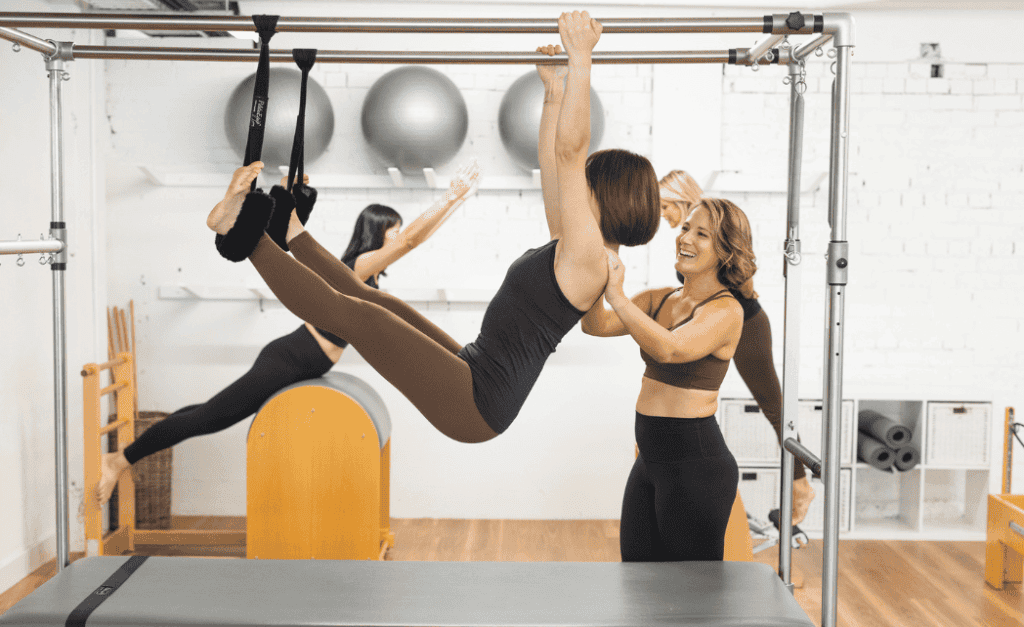
- Technique and alignment feedback comes through hands-on cues that help you adjust your form as you move.
- Goal-specific exercises let one partner focus on core strength while the other works on flexibility.
- Adjusting exercise difficulty lets your instructor change spring resistance to suit your current strength and control.
- Different fitness levels don’t have to prevent you from training together: your instructor can adjust the challenge for a beginner and a more experienced partner.
How Reformer and Tower Sessions Help Keep Your Routine Engaging
Body Cadence uses its Pilates Designs equipment for alternating reformer and tower weeks, switching setups every other week.
On reformer weeks, you work on a sliding carriage with spring resistance. Changing the springs alters how challenging a familiar movement feels, while guiding the carriage back smoothly calls for control.
On tower weeks, you use a spring-loaded frame with a push-through bar. The springs can either support or challenge movements such as roll-downs and leg work, providing a different way of working on strength and flexibility.
Your partner and regular time slot can stay the same even as the equipment changes, giving you a different experience without disrupting your routine.
How to Measure Progress Without Losing Motivation
You don’t have to rely on appearance alone to judge your progress. Attendance, movement control and confidence can all show how your practice is developing.
- Consistent attendance is a useful first marker: making it to your booked sessions for a month suggests that the routine is becoming a habit.
- Improved movement control shows up in smoother repetitions and more consistent alignment during familiar exercises.
- Core stability is on the reformer when you can keep your pelvis absolutely still as the carriage moves.
- Flexibility and mobility will improve when the roll-downs on the tower feel so restricted and your range of motion is more comfortable.
- Exercise confidence grows as familiar exercises become easier to follow and you feel more comfortable moving through them, while still asking for cues when you need them.
- Personal milestones, like your first full roll-up (harder than it looks), give you and your partner something to celebrate, even when you’re working toward different goals.
Is Semi-Private Pilates the Right Fit for Your Fitness Routine?
Semi-private Pilates fits your routine if you want personal guidance and a workout partner at a lower price than private sessions. The table below compares it with Body Cadence’s other two formats.
| Format | Who trains | Best for |
| Private Pilates | Just you | Customized one-on-one coaching |
| Semi-private Pilates | You and one friend | Personal guidance with shared accountability |
| Group Pilates | A scheduled class | Class energy on a set timetable |
Book Semi-Private Pilates Sessions & Keep Moving Toward Your Fitness Goals!
Booking with a friend can help you stay accountable, and your instructor can tailor exercises to your needs. Alternating between reformer and tower sessions from week to week also adds variety to your routine.
At Body Cadence in Toronto, you can choose between these semi-private Pilates options:
| Booking option | Details | Price |
| Introductory semi-private session | 55 minutes | $65 |
| First-time five-session pack | Available to new clients | $275 |
So, why work out alone? Try semi-private Pilates with a friend at Body Cadence.
Frequently Asked Questions (FAQs)
Q1. Does Pilates actually get you toned?
Pilates can be a very effective way of building muscle strength and control, which in turn can lead to a more defined physique. At Body Cadence, we have the reformer and tower springs to provide resistance and the instructor can obviously vary that to suit your ability.
Q2. What area of your body does Pilates target?
Pilates is all about the core, the abdominal and back muscles. Depending on the exercises of course, the reformer and tower work will also engage your arms and legs to a degree so it’s not just a core exercise.
Q3. How many times a week should you go to a Pilates class?
For many people, two sessions a week will be a perfectly sensible starting point, although the right frequency will, of course, come down to individual goals and recovery. The 12 week study referenced above used two sessions per week but that schedule isn’t necessarily ideal for everyone. Planning your sessions with a semi-private partner can help you stick to your routine.
Q4. Does Pilates flatten your belly?
Pilates can strengthen your core, but it won’t specifically burn fat around your belly. Regular sessions can improve core strength, while balanced eating and overall physical activity can support fat loss across your body.
